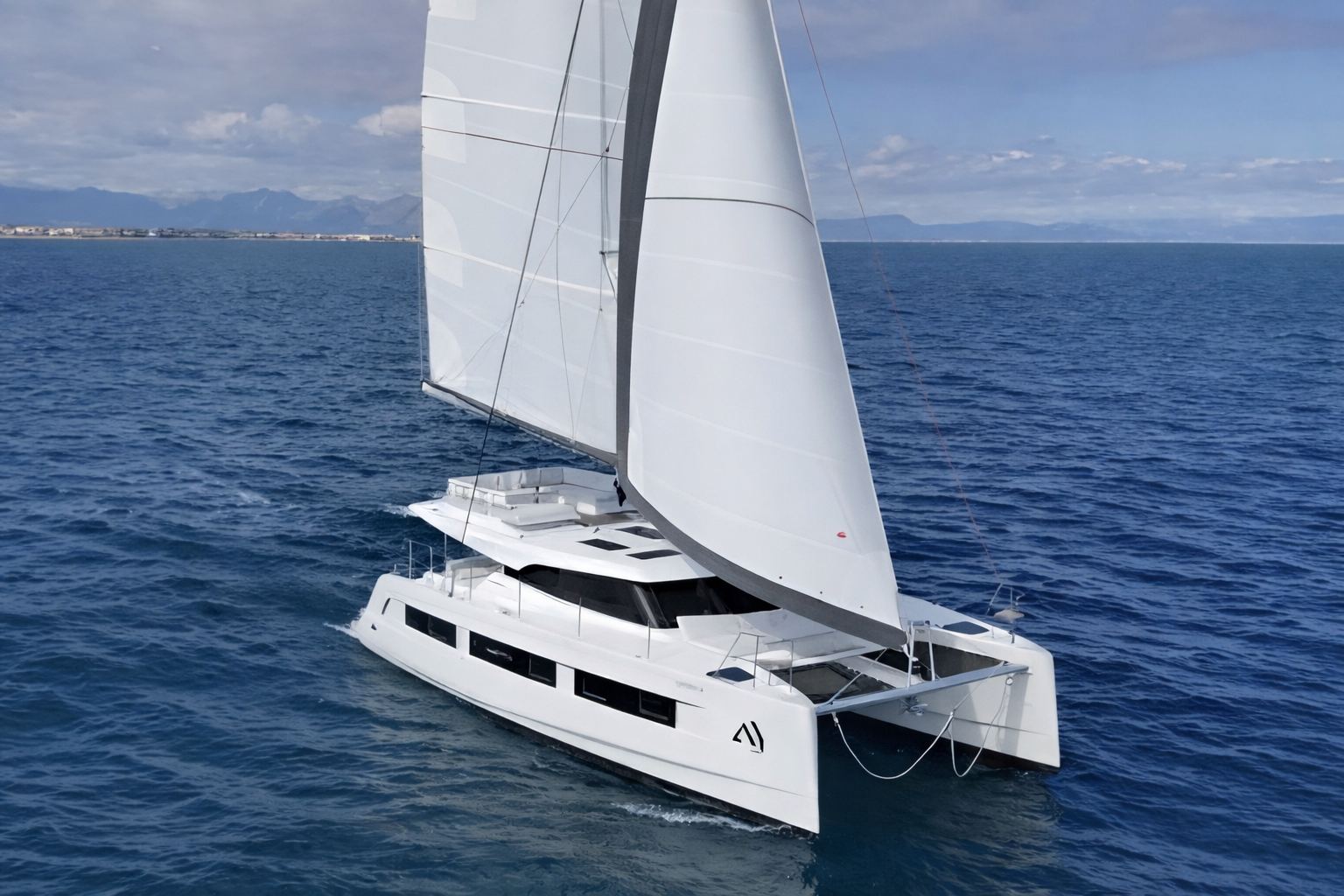
Guide
How to choose a catamaran for the Gulf
Five questions that narrow the choice down to two or three Aventura models. It takes about ten minutes; figures are according to the shipyard.
How to use this guide
There is no such thing as a good boat “in general”. There is a boat that suits your waters, your crew and the way you like to spend time on the water.
Answer the five questions in order. Each answer rules out part of the range, and the table at the end suggests the two or three models to start with.
1. Where will you sail?
- Around the marina and nearby islands. Shallow draft, easy berthing, a quick exit from the marina and shade on deck matter most.
- Across the Gulf and to Oman. You need water and fuel for several days without a port call, and enough power to run the air conditioning at anchor.
- Further: the Red Sea or the Indian Ocean. Look at the CE design category, the tank capacity and how the boat carries a load.
The CE category shows what conditions the boat is designed for. A — wind above force 8 and waves above 4 m. B — up to force 8 and 4 m. C — up to force 6 and 2 m. It is a design rating, not a permission to go out in a storm.
2. Who will be aboard?
- A couple or a family of up to four. Three cabins: one for you, two for guests. This is often an owner's version, where one whole hull is the owner's suite.
- A large family and friends, 6–10 people. Four cabins or more, ideally with a bathroom for each.
- Charter. As many cabins of the same size as possible, and simple maintenance.
The number of cabins on one model can vary. For example, the Aventura 45 and the Aventura 48 are built with three, four, five or six cabins (according to the shipyard). Choose the layout for your usual crew, not for one party a year.
3. Sail or power?
- Sailing catamaran. Quiet passages and low fuel use. The price is time and a willingness to work the sails.
- Power catamaran. Less dependent on the wind, so the day is easier to plan. More deck space and a flybridge; fuel use is higher.
- Long-range power catamaran. Small, economical engines and larger tanks: slower, but it goes far. At Aventura this is the Explorer line.
Ask yourself honestly: do you enjoy sailing itself, or does it matter more to be in the bay by lunchtime?
4. On your own or with a captain?
Up to 13–14 metres, a couple can handle a catamaran if the lines are led to the helm station and the view from it is good.
At 15–17 metres the deck layout decides everything: electric winches, autopilot, bow thrusters. Check that the two of you can berth the boat in a crosswind.
If you plan to have a captain, decide this early: a crew cabin is easier to plan into the layout than to add later.
5. Heat and shade
In the Gulf, comfort on board depends as much on the climate as on the layout. Check four things before you choose:
- Shade. A hardtop or a flybridge over the cockpit: where will you sit at noon?
- Air conditioning. For every cabin and the saloon, not only the owner's cabin.
- Power at anchor. A generator, and ideally solar panels and lithium batteries, so the air conditioning can run quietly at night.
- Fresh water. A watermaker means you can stay at the islands for days.
Where to start
| Your plans | Models to look at |
|---|---|
| Weekends near home, under power | Aventura 38 S, 38 SC, 38 Sedan, 38 FLY |
| First sailing boat, family holidays | Aventura 37 |
| Season cruising with family and guests | Aventura 43, Aventura 45 |
| A large group or charter | Aventura 45, Aventura 48, Aventura 56 MY |
| Long passages, living aboard | Aventura 48 (CE category A) |
| Long range under power | Aventura 37 Explorer, 47 Explorer, 56 MY |
| Shallow warm waters | Aventura 38 S and 38 SC, Aventura 37 Explorer, Aventura 37 |
| Day trips with guests | Aventura 37 DC (up to 28 passengers), Aventura 45 DC (up to 60 passengers) |
Draft according to the shipyard: Aventura 38 S and 38 SC — 0.78 m, Aventura 37 Explorer — 0.94 m, Aventura 37 — 1.2 m.
What to check on board
- Bridgedeck clearance — the height from the water to the underside of the deck between the hulls. A guide figure is 5–6% of the boat's length; 4% is acceptable but is the lower limit (Lagoon shipyard guide). With too little clearance, waves slam into the underside.
- Payload. Ask how much load the boat carries on top of its own weight. An overloaded catamaran quickly loses speed.
- View from the helm. Can you see all four corners of the boat when berthing?
- Shade. Where you sit at noon: a hardtop over the cockpit, a flybridge, a bimini.
- Engine access. Can you check the oil and filters without taking a cabin apart?
- Saloon and cockpit on one level. No threshold or steps between them — it makes a difference every day.
The full cost of ownership
The price of the boat is only the first line. Work out the rest in advance:
- taxes and customs duty on purchase and import;
- flag and registration;
- delivery from the shipyard to your home port;
- marina berth;
- insurance;
- annual maintenance: engines, sails, underwater hull;
- a captain or crew, if you need one;
- extra equipment for your cruising area.
Ask us for this list for your country and your marina — the figures vary a lot.
New or pre-owned?
New. You choose the layout, engines and equipment and get the shipyard warranty. The build takes time, depending on the model and the shipyard schedule.
Pre-owned. The boat is already on the water, often with extra equipment from the previous owner. An independent survey with the boat out of the water and a check of the documents are essential before you buy.
What to look at on a pre-owned boat: engine hours and service history, the age of the sails and standing rigging, signs of impact or moisture in the hull, the condition of the electrics and batteries.
What next
Write down your five answers: where you will sail, who is aboard, sail or power, on your own or with a captain, and what matters most to you in the heat.
Send them to us on WhatsApp or through the form below — we will suggest two or three Aventura models for your plans and explain how they differ.
Contact
Send us your five answers
We reply personally, usually within a day.